What Is Operational Intelligence? | KaiMesh
Learn how operational intelligence uses connected data to identify changing situations, surface risks and opportunities, and support accountable action.
Operational Intelligence uses current business data to understand changing situations and support timely action. Its foundation is connected data: records and signals that can be related across systems, documents, conversations and teams.
KaiMesh is a business data intelligence platform. Operational Intelligence is one application of that foundation, alongside business questions, analytics, customer insight and opportunity discovery.
Most businesses already have more data than they can use.
They have customer records, financial systems, project plans, support tickets, email threads, meeting transcripts, system logs, inventory counts, shipment updates, sensor readings, production schedules, contracts, workforce data, and hundreds of metrics changing every day.
The problem is not that the information does not exist.
The problem is that each system sees only its own part of the operation.
A customer platform can show an open account. A project system can show a delayed milestone. An email thread can contain a serious concern. A meeting transcript can contain a promise nobody formally recorded. A billing system can show the revenue at risk. Every system can be accurate while the organization still fails to understand what is happening.
Operational Intelligence exists to close that gap.
For this guide, we use an action-oriented working definition of Operational Intelligence:
The continuous process of turning live signals from people, processes, software, and physical operations into contextual understanding, prioritized decisions, coordinated action, and verified outcomes.
Both data quality and follow-through matter. A timely finding needs a clear evidence trail; a completed action needs a separately measured business result.
Operational Intelligence is not complete when a dashboard changes color or an alert reaches someone’s inbox. It is complete when the organization understands what is happening, why it matters, who should act, what should happen next, and whether that action actually occurred.
That is the difference between observing a business and operating one intelligently.
Operational Intelligence is not reserved for companies with command centers. A growing business can benefit whenever a decision depends on context spread across people and tools.
The established definition, and where it needs to go deeper
Salesforce defines Operational Intelligence as the real-time analysis of data to improve decision-making and operational efficiency. In its customer-service context, that means using current interaction and contact-center data to anticipate issues, adjust workflows, improve response times, and act before customer problems become larger.
That is a useful definition. It captures three foundational ideas:
- Operational Intelligence concerns what is happening now.
- Its purpose is better decision-making.
- The insight should improve an active operation, not merely explain the past.
The category, however, is much larger than customer service.
IBM describes real-time data as information available for processing almost immediately after it is generated. IBM points to fraud detection, supply-chain optimization, personalized customer experiences, and risk management as examples of where fresh data creates value.
SAP’s explanation of supply-chain control towers expands the concept further. It describes collecting structured and unstructured signals from barcodes, sensors, IoT systems, weather, traffic, planning, manufacturing, inventory, and order management, then using that combined context to anticipate disruptions and guide a response.
Microsoft’s supply-chain reference architecture shows the same pattern across ERP data, logistics feeds, vendor networks, inventory, contracts, forecasting, risk scoring, and automated escalation. Splunk applies the principle to industrial and physical operations by connecting IT and operational technology data for asset health, efficiency, root-cause analysis, and proactive management. Atlassian applies it to engineering incidents by grouping related alerts, enriching incident context, accelerating root-cause analysis, and helping technical teams act on the signals that matter.
Each company naturally explains Operational Intelligence through the part of operations it serves. Taken together, the category becomes much clearer.
Operational Intelligence can support customer service, supply chains, engineering and other functions. Vendor scope varies: category examples do not establish that any one product includes every capability listed here.
It applies anywhere that:
- Important signals arrive continuously.
- The meaning of one signal depends on another.
- A delay in understanding creates cost or risk.
- Someone must decide or act before the situation changes.
- The outcome needs to be tracked, not assumed.
Real-time is not always the same as right-time
Operational Intelligence is commonly described as real-time intelligence, but not every business decision needs to happen in milliseconds.
A payment fraud decision may need to happen before a transaction is approved. A production-line anomaly may require action within seconds. A supply shortage might create a nine-hour intervention window. A customer relationship may deteriorate over several days. A professional-services project may show compound risk two weeks before a critical milestone.
The correct standard is therefore not simply real-time. It is right-time intelligence.
Right-time intelligence means that context reaches the right person early enough to preserve meaningful choices.
If a system identifies customer churn only after cancellation, it may still support learning or recovery, but it has missed the earlier opportunity to intervene. If it identifies the combination of declining engagement, unresolved commitments, delivery pressure, negative sentiment, and renewal exposure while the account can still be recovered, it has created an intervention window.
That window is where Operational Intelligence produces its value.
From signal to outcome
A mature Operational Intelligence system does more than collect and visualize data. It moves through a closed operational loop.
1. Sense
The system continuously receives signals from the operation.
These may include transactions, messages, emails, meeting decisions, support activity, project updates, machine telemetry, delivery events, inventory changes, staffing data, customer feedback, financial exposure, external weather, traffic, market events, or supplier risk.
2. Connect
Raw signals become useful when the system connects them to shared operational entities.
Who is the customer? Which shipment supports which order? Which engineer owns the affected service? Which contract contains the penalty? Which project depends on the delayed component? Which revenue is connected to the account? Which commitment was made, by whom, and for when?
This is why moving data into one warehouse is not enough. Data proximity does not automatically create operational context.
3. Interpret
The system determines what the connected signals mean together.
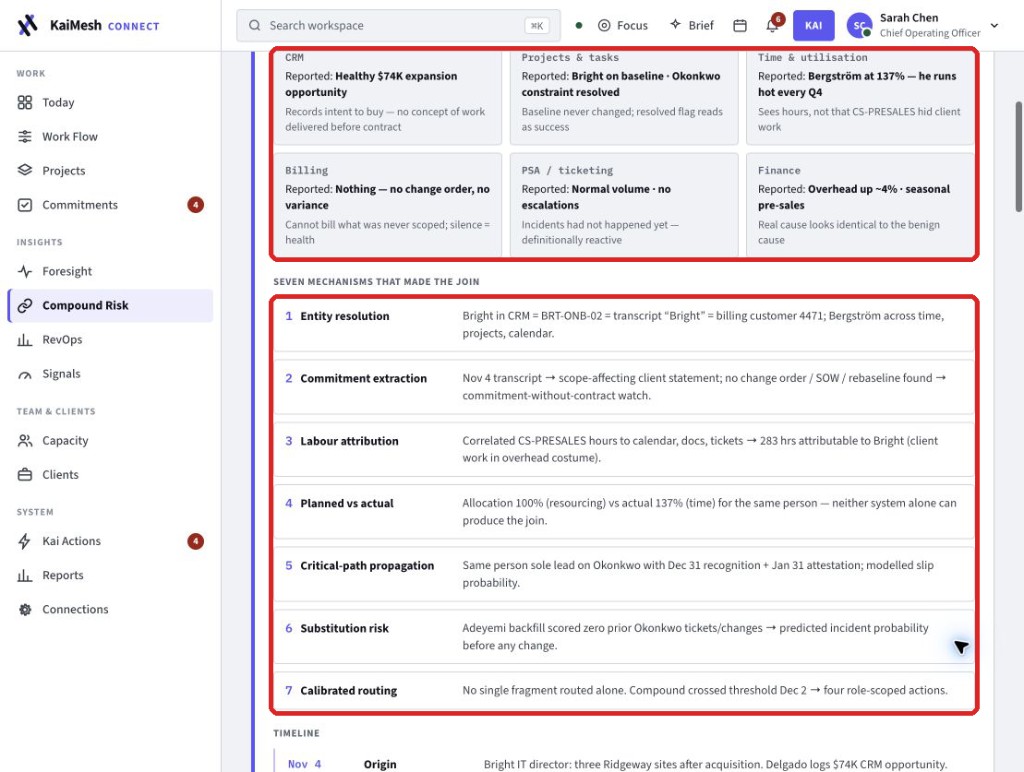
One delayed task may be routine. A delayed task attached to a customer escalation, an unresolved commitment, an overloaded owner, and a renewal in 21 days represents a different situation.
The individual signals are not necessarily severe. Their relationship is.
We call this compound risk.
4. Prioritize
An operation can produce thousands of anomalies. Leaders cannot treat every deviation as urgent.
Operational Intelligence should rank findings using business context such as financial exposure, customer importance, safety, contractual obligations, downstream dependencies, urgency, reversibility, and the time remaining to intervene.
The goal is not to create more alerts. The goal is to help the organization distinguish what is unusual from what is important.
5. Recommend or decide
The system explains the available response.
This may include rerouting a shipment, reallocating inventory, escalating a customer concern, moving engineering capacity, assigning an owner, drafting a communication, updating a record, opening an incident, scheduling a follow-up, or presenting a human decision-maker with several scenarios and their likely impact.
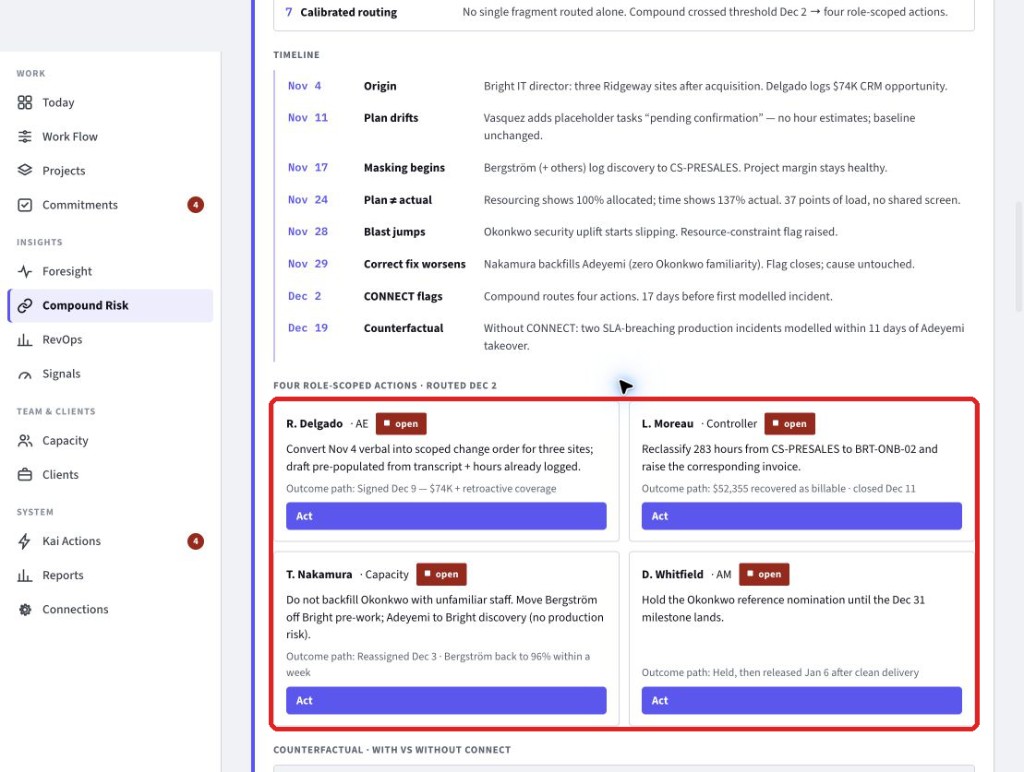
6. Coordinate action
An insight that does not enter the workflow is easy to ignore.
Operational Intelligence must connect the recommendation to the people and systems that execute it. That could mean creating the task, notifying the accountable leader, drafting the customer message, updating the service record, or triggering an approved automated workflow.
7. Verify and learn
The system checks whether the action occurred and whether it improved the outcome.
Was the backup shipment confirmed? Did the account owner contact the customer? Was the engineering rollback completed? Did the risk level decline? Was the deadline recovered? Was the recommendation useful, rejected, or based on incomplete context?
Without verification, a business has alerting. With verification, it begins to develop operational learning.
This sense, connect, interpret, prioritize, act, and verify loop is central to the way KaiMesh approaches connected intelligence.
How operational context complements dashboards
Dashboards remain valuable. They summarize performance, expose trends, and help leaders explore known questions.
Operational Intelligence serves a different purpose.
A dashboard might show that inventory is below plan.
Operational Intelligence explains that current inventory cannot cover committed orders, the primary replenishment is 11 hours late, the backup carrier is unconfirmed, receiving capacity is constrained, weather threatens the alternative route, two affected orders have penalties, and the organization has roughly nine hours to intervene.
A dashboard can show both state and business context when those relationships are modeled. The practical requirement is that people can inspect the affected commitments, feasible responses and ownership without reconstructing them from scratch.
The distinction can be summarized simply:
- Business Intelligence supports analysis of historical and current information, and can include predictive analytics, alerts and action integrations.
- Operational Intelligence helps a company understand a changing situation and act while the outcome is still influenceable.
- Observability helps teams infer the internal state of technical systems from telemetry such as logs, metrics, and traces.
- Automation executes a defined action or workflow when conditions are met.
- Data integration moves and synchronizes data between systems.
- Operational Intelligence connects these capabilities with business context, prioritization, decision support, coordinated execution, and verification.
These categories can work together. They are not interchangeable.
What Operational Intelligence looks like in a small business
The scenarios in this guide are illustrative. Their quantities explain the decision logic; they are not KaiMesh customer outcomes or a claim that every described source or automation is available in every implementation.
Small businesses often assume Operational Intelligence is an enterprise concept because they do not have enormous factories, global supply networks, or dedicated data teams.
In reality, smaller companies can experience a more concentrated version of the same problem.
A 20-person firm may use fewer systems, but critical context is often concentrated in individual people. The founder remembers the customer promise. The project lead understands the delivery constraint. The account manager knows the relationship is tense. The bookkeeper sees the unpaid invoice. None of that knowledge is available as a connected operating picture.

Consider a 25-person IT services firm:
- A large customer opens several support tickets in one week.
- The tone of the latest email is more negative than usual.
- A promised network upgrade has slipped twice.
- The engineer assigned to the account is also the sole owner of another critical cutover.
- The customer’s agreement renews next month.
- The latest invoice remains unpaid.
No single signal proves the customer will leave. Together, they justify review by the account owner, who can confirm whether the records reflect a shared issue.
Operational Intelligence can connect those signals, estimate the exposure, identify the owner, recommend an account review, prepare the relevant history, draft the outreach, and confirm that follow-up occurred.
For smaller teams, the value is not a massive analytics program. It is reduced dependency on memory, fewer missed handoffs, better prioritization, and earlier intervention.
For a growing team, KaiMesh starts from fragmented business data rather than a requirement to replace its applications. Agreed sources can contribute the facts behind a customer question, an analytical comparison or a proactive finding. Source scope, permissions and review responsibilities should be established during implementation.
What Operational Intelligence looks like in supply chains
Supply-chain intelligence becomes valuable when inventory, transportation, labor, contracts, customer commitments, and external conditions are interpreted as one changing situation.
Supply chains demonstrate why cross-system context matters.

Imagine a distributor with 14,200 units available at one distribution center and 18,000 units committed over the next 36 hours. That gap alone is important, but it is not the complete operational finding.
The primary inbound shipment is 11 hours late. The backup carrier has not confirmed. Receiving capacity is at 62 percent. A weather event threatens the backup route. Seven customer orders may be affected. Two have contractual penalties.
The operational question is not, “What is our inventory?”
It is:
Given inventory, committed demand, inbound status, labor capacity, external disruption, customer priority, and contract exposure, what will happen, when will it happen, what is financially at risk, and which response preserves the best outcome?
Operational Intelligence can correlate WMS, OMS, TMS, ERP, procurement, workforce, contract, weather, and customer data to answer that question. It can model downstream impact, recommend inventory reallocation, compare supplier or carrier alternatives, identify affected customers, and coordinate the response.
Large enterprises may run this across hundreds of facilities and thousands of suppliers. A regional distributor may apply the same principle across two warehouses, three carriers, and a spreadsheet. The scale changes. The operating logic does not.
What Operational Intelligence looks like in engineering
Technical telemetry becomes Operational Intelligence when it is connected to deployments, ownership, customers, commitments, and business impact.
Engineering teams have extensive observability, but technical visibility alone does not always explain operational impact.

A latency spike is a technical signal. To become an operational finding, the organization may also need to know:
- Which deployment preceded the change?
- Which services and dependencies are affected?
- Which customers use those services?
- Are any of those customers in an onboarding, renewal, or high-volume period?
- Which service-level commitments apply?
- Who owns the affected component?
- Is the owner available?
- What changed during the last similar incident?
- Should the team roll back, fail over, reduce load, or communicate first?
Operational Intelligence connects engineering telemetry with incident records, deployments, service ownership, customer impact, contracts, support volume, revenue exposure, and response workflows.
This reduces the distance between “something is wrong” and “this is what matters, this is who owns it, and this is the safest next action.”
For a startup, that may mean connecting GitHub, cloud monitoring, customer support, and team chat. For an enterprise, it may require a governed service graph, multiple observability platforms, change-management data, regional ownership, compliance controls, and human approval for high-impact actions.
What Operational Intelligence looks like across other operations
The same model applies well beyond these examples.
Customer operations
Connect interaction volume, sentiment, unresolved issues, product usage, commitments, account value, renewal timing, and service performance. The goal is not merely to predict churn, but to identify the practical intervention, assign ownership, and ensure follow-through.
Professional services and project delivery
Connect scope, milestones, capacity, blockers, decisions, client sentiment, change requests, billing, and commercial commitments. A project may appear green in the project plan while client communication, staffing, and unapproved scope reveal significant delivery risk.
Manufacturing
Connect equipment telemetry, maintenance history, quality results, production schedules, material availability, staffing, energy use, and customer orders. The finding should explain not only that a machine is degrading, but which production commitments are threatened and when maintenance creates the lowest total impact.
Field service
Connect asset condition, technician location, skill, parts availability, customer priority, service history, traffic, weather, and contractual response times. Operational Intelligence can identify likely failures, select the appropriate response, and prepare the technician with the context needed to resolve the issue on the first visit.
Healthcare operations
Within appropriate privacy, safety, and regulatory controls, connect staffing, capacity, equipment availability, patient flow, scheduling, and supply levels to identify operational constraints before they affect care delivery.
Financial and risk operations
Connect transactions, identity signals, account history, policy rules, network activity, and external risk indicators. Here, the intervention window may be measured in milliseconds, and the system may need to block, route, or escalate an action immediately.
Why Operational Intelligence matters
The business case is broader than efficiency.
It reduces decision latency
Decision latency is the time between the first meaningful signal and an informed action.
Organizations often measure process duration but ignore how long critical context sits unconnected. A warning remains in an inbox. A dependency remains in a meeting note. A change in customer behavior remains in an analytics tool. The business loses time before anyone even recognizes that a decision is required.
Operational Intelligence compresses the interval between signal, understanding, and action.
It increases the intervention window
Earlier understanding preserves more options.
A company that sees a supply risk nine hours earlier can move inventory, change carriers, prioritize receiving, or communicate with customers. A company that sees churn risk three weeks earlier can repair a relationship. An engineering team that connects an anomaly to a deployment and affected accounts quickly can limit impact before support volume surges.
The value is often not perfect prediction. It is earlier optionality.
It exposes compound risk
Risk can emerge from interacting conditions. Some existing analytics and specialist systems already model these relationships; the remaining gap depends on the sources and dependencies included in the implementation.
The overloaded engineer is not automatically a crisis. The delayed milestone is not automatically a crisis. The unresolved customer commitment is not automatically a crisis. When the same engineer owns the delayed milestone for a customer who is already dissatisfied and approaching renewal, the combination changes the risk.
Operational Intelligence makes those relationships visible.
It reduces alert fatigue
More monitoring usually creates more alerts. More alerts do not necessarily create better decisions.
Operational Intelligence should group related signals, suppress duplication, add business context, and rank findings by impact and urgency. Engineering platforms already apply this principle by clustering alerts. The broader opportunity is to do the same across technical, customer, financial, and operational domains.
It protects institutional knowledge
Much of a company’s operating intelligence lives in people’s memories.
Experienced operators know which customer needs a phone call instead of an email, which supplier delay is harmless, which metric becomes dangerous in combination with another, and which commitment was made informally during a meeting.
An effective system captures decisions, outcomes, and operational relationships so the organization can learn without monitoring employees or attempting to replace human judgment.
It connects insight to accountability
Most failures do not happen because nobody could imagine the right action. They happen because ownership was unclear, the action remained outside the workflow, or nobody checked that it was completed.
Operational Intelligence connects every important finding to an owner, a deadline, a response, and a verification step.
Opportunity discovery belongs in the same loop
Earlier intelligence is useful when conditions improve, too. Imagine that a customer has adopted an additional product workflow, resolved its service issues and asked about support in a new region. Connected account records, conversation history and regional capacity could justify an expansion discussion. The finding should show what changed, the evidence for fit, who owns the conversation and what still needs validation.
A purchasing team might instead identify that compatible demand across locations can be combined before an order is placed. An operations leader might find available capacity that can fulfill a new commitment. These are illustrative applications, not KaiMesh customer results. Measure the accepted opportunity and eventual outcome separately: a promising signal is not booked revenue.
Business data intelligence supports both requested analysis and proactive discovery. Proactive intelligence is the capability that brings a material change to attention before someone asks the question.
The role of AI
AI can make Operational Intelligence significantly more capable, but AI is not the category by itself.
Machine learning can detect anomalies, rank risks, estimate likely outcomes, and identify patterns humans would struggle to monitor at scale. Language models can interpret unstructured material such as messages, documents, transcripts, notes, and contracts. Agentic systems can prepare or execute actions across connected workflows.
The value depends on context and control.
An AI model without operational context may produce a fluent but generic recommendation. An AI system with access to connected entities, permissions, live signals, business rules, history, and outcome feedback can produce a recommendation grounded in the actual operation.
This is part of the KaiMesh approach: connect business data so AI can help answer questions and surface meaningful changes with evidence. A proposed action still needs the appropriate owner and review. Specific source coverage and automation boundaries should be demonstrated for the intended workflow.
Responsible Operational Intelligence should include:
- Clear data lineage and source attribution.
- Permission-aware access to sensitive context.
- Confidence levels and uncertainty where appropriate.
- Human approval for consequential actions.
- Audit trails for recommendations and execution.
- Rules for safety, privacy, regulatory, and contractual boundaries.
- Feedback on whether recommendations were useful and outcomes improved.
- The ability for operators to correct assumptions and override decisions.
The purpose is not autonomous decision-making everywhere. The purpose is the right balance of machine speed and human judgment for each operating situation.
Small business and enterprise require different architectures, not different definitions
Operational Intelligence should be accessible at both ends of the market.
For small and growing businesses
The best starting point is usually one high-value operating problem and a small number of sources.
A firm might begin with customer communication, meetings, projects, support, and billing. It does not need a data lake or a transformation program. It needs a shared model of customers, commitments, work, owners, deadlines, and financial impact.
Implementation should prioritize a useful answer and manageable maintenance. Start with the source records required for that answer, identify conflicting definitions, and measure the review effort as well as time saved. KaiMesh implementation is scoped to the business situation; no universal delivery timeline follows from company size.
For enterprises
The objective is not necessarily to replace core systems. It is to create an intelligence layer that respects the architecture already in place.
Enterprise Operational Intelligence may need to connect ERP, CRM, WMS, TMS, MES, ITSM, observability, workforce, finance, data platforms, communication systems, external feeds, and industry-specific applications.
The architecture must account for domain ownership, identity resolution, data residency, permissions, latency, lineage, reliability, model governance, and the consequences of automated action.
Enterprises should avoid trying to centralize every byte before producing value. A better approach is often to establish a shared operational model, connect the sources required for one valuable decision loop, prove the outcome, and expand domain by domain.
The scale and governance are different. The central question remains the same:
Can the organization understand a changing situation and coordinate the right response before the outcome becomes unavoidable?
A practical maturity model
Organizations typically develop Operational Intelligence in stages.
Level 1: Fragmented awareness
Data exists across tools and people. Leaders discover important issues through meetings, escalations, and manual follow-up.
Level 2: Central visibility
Dashboards and reports provide a more consistent view, but people still interpret relationships and coordinate responses manually.
Level 3: Connected context
The organization links shared entities such as customers, orders, assets, projects, services, commitments, owners, and revenue across systems.
Level 4: Proactive intelligence
The system detects compound conditions, explains impact, prioritizes findings, and recommends actions within the relevant intervention window.
Level 5: Closed-loop operations
Recommended or approved actions enter workflows automatically. The system verifies completion, measures the result, and improves future recommendations.
Most organizations should not begin by targeting full autonomy. They should begin by improving one decision loop that is currently expensive, slow, or dependent on manual context stitching.
How to measure Operational Intelligence
The success of Operational Intelligence should not be measured by dashboard views, alert volume, or the number of models deployed.
Useful measures include:
- Time from signal to detection.
- Time from detection to informed decision.
- Time from decision to action.
- Percentage of critical findings with a clear owner.
- Percentage of recommended actions completed within the intervention window.
- False-positive and duplicate-alert rates.
- Actual changes in revenue, margin, downtime or penalties, with estimated avoided exposure reported separately.
- Reduction in manual reconciliation and status preparation.
- Improvement in on-time delivery, first-time resolution, retention, service levels, or incident recovery.
- Operator acceptance, correction, and override rates.
- Whether the system can explain which evidence produced a finding.
The best metric is often specific to the operating loop. A distribution team may measure avoided expedite cost and protected on-time delivery. An engineering organization may track detection time, business-impact identification, and recovery time. A services firm may measure early risk detection, recovered milestones, and retained revenue.
What good Operational Intelligence should feel like
It should not feel like another system demanding attention.
It should feel like the organization is becoming harder to surprise.
Leaders should see fewer but more meaningful findings. Teams should receive context with the request, rather than being sent to search five systems. Ownership should be clear. Actions should be easier to execute. Follow-through should be visible. The system should explain why something matters without hiding uncertainty.
Most importantly, Operational Intelligence should strengthen operators.
It should make the account manager better prepared, the warehouse leader earlier, the engineer more focused, the project manager less dependent on manual status collection, and the executive more confident that the organization is acting on the right issues.
That is the actual value proposition.
The goal is better operational judgment, applied earlier, with connected data to support the decision and follow-through to establish what happened.
The question every organization should ask
When an important customer, delivery, system, project, asset, or supply commitment begins to go wrong, who understands it first?
Your operation, or the person affected by the failure?
If the answer is usually the customer, the executive escalation, the missed deadline, or the incident report, the warning signs may not be absent. They may simply be disconnected.
Operational Intelligence is how organizations connect them while there is still time to change the outcome.
Explore Operational Intelligence
Continue with the comparison and use-case guides in this cluster:
- Operational Intelligence vs Business Intelligence
- Why Dashboards Do Not Stop Operational Fire Drills
- How to Measure the Cost of Operational Fragmentation
- Operational Intelligence vs Process Intelligence
- Operational Intelligence vs Decision Intelligence
- Operational Intelligence vs AIOps
- Operational Intelligence vs a Control Tower
- Operational Intelligence for Supply Chains
- Operational Intelligence for Engineering Teams
- Operational Intelligence for Commercial Contracting
- Operational Intelligence for Field Operations
- Operational Intelligence for Professional Services
- Operational Intelligence for Multi-Site Businesses
- What is Adaptive Predictive AI?
- What is AI Business Intelligence?
- What is Compound Operational Risk?
Frequently asked questions
What is Operational Intelligence?
Operational Intelligence uses current business signals to understand changing situations, prioritize a response and follow the outcome. It depends on connected data, relevant context and accountable action.
How is Operational Intelligence different from Business Intelligence?
BI supports analysis of historical and current data, and can include forecasts and alerts. Operational Intelligence emphasizes changing operating situations and timely response. The capabilities overlap; evaluate the configured sources, evidence and workflows.
How does Operational Intelligence relate to business data intelligence?
Business data intelligence connects fragmented records and signals to support questions, analytics, risks, opportunities and action. Operational Intelligence is a timely operational application of that foundation.
Does this require replacing existing systems?
Not necessarily. Start with the records and relationships needed for the selected question. Existing applications can remain authoritative; source coverage, access and action boundaries need to be agreed for the implementation.
Explore KaiMesh business data intelligence, see how it works or contact the team for a free 30-minute workflow review. No system access or paid commitment is needed for the first conversation.
Frequently asked questions
What is Operational Intelligence?
Operational Intelligence uses current business signals to understand changing situations, prioritize a response and follow the outcome. It depends on connected data, relevant context and accountable action.
How is Operational Intelligence different from Business Intelligence?
BI supports analysis of historical and current data, and can include forecasts and alerts. Operational Intelligence emphasizes changing operating situations and timely response. The capabilities overlap; evaluate the configured sources, evidence and workflows.
How does Operational Intelligence relate to business data intelligence?
Business data intelligence connects fragmented records and signals to support questions, analytics, risks, opportunities and action. Operational Intelligence is a timely operational application of that foundation.
Does this require replacing existing systems?
Not necessarily. Start with the records and relationships needed for the selected question. Existing applications can remain authoritative; source coverage, access and action boundaries need to be agreed for the implementation.