Key takeaways
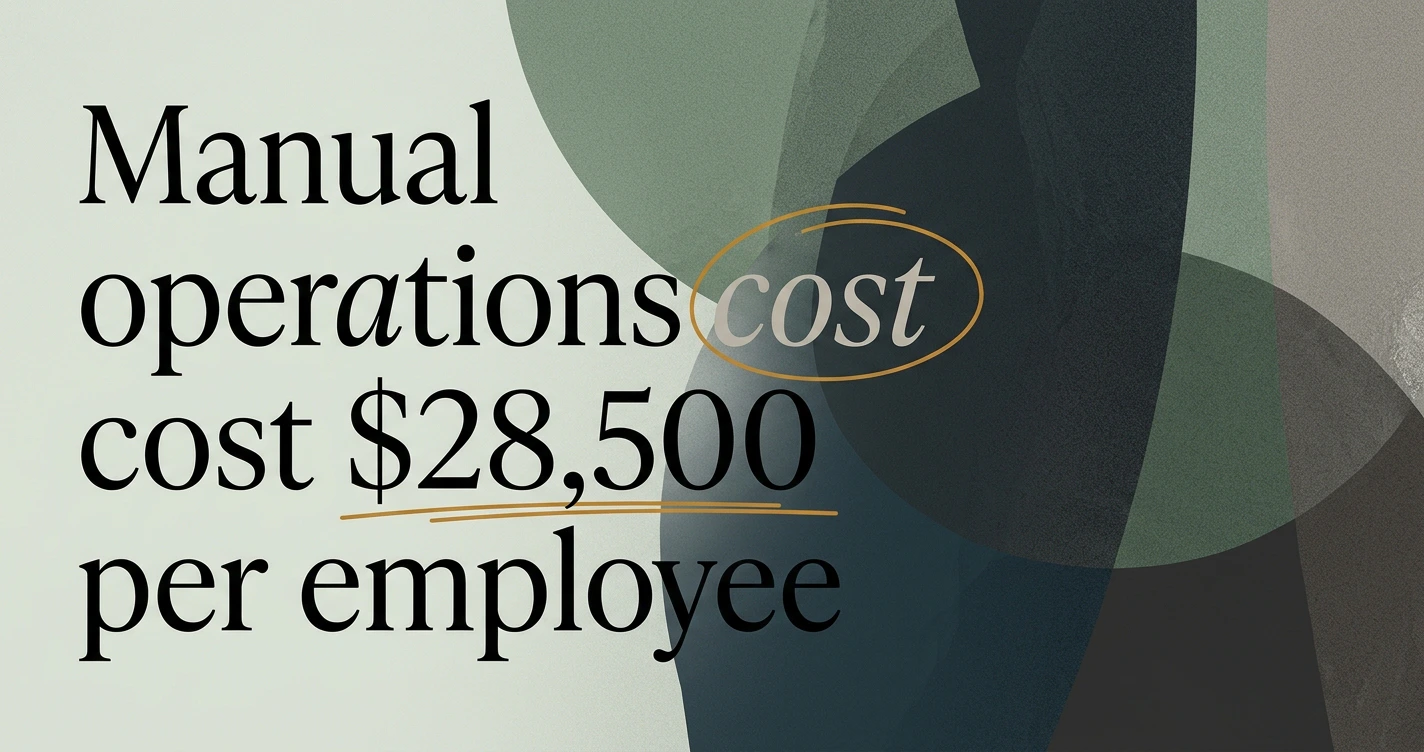
- Manual data entry costs American companies an average of $28,500 per employee each year, according to a 2026 Parseur and QuestionPro survey.
- Employees spend 9 or more hours a week on manual data entry, time that rarely shows up on any budget line.
- Just over half of employees (50.4%) say manual entry has led to costly errors, delays, or missed opportunities.
- The most expensive manual work is often invisible: senior staff doing coordination and rework instead of judgment calls.
- Start automation where volume, error rates, and approval delays overlap, not with the flashiest process.
Manual operations work costs far more than the hours on a timesheet. The hidden costs of manual operations show up as rework, errors, compliance exposure, and skilled people buried in busywork instead of decisions. A 2026 Parseur and QuestionPro survey put the average cost of manual data entry at $28,500 per employee each year, and most of that spend never appears as a line item anyone reviews.
That is the problem with manual work. It hides inside salaries, meetings, and "that is just how we do it." This article breaks down where those costs come from, how they grow as you scale, and where to cut them first.
The Hidden Costs of Manual Operations Start With Lost Time
In 2026, a Parseur and QuestionPro survey found that employees spend 9 or more hours a week on manual data entry alone (Parseur, Manual Data Entry Report, 2026). Coordination work sits on top of that: chasing status updates, re-keying the same figures into three systems, and reconciling spreadsheets that should already agree.
Rework is the quiet multiplier. When a number is entered wrong once, someone later has to find it, question it, correct it, and re-send whatever depended on it. One bad field can trigger an hour of cleanup across several people.
Most of this time is invisible because it is spread thin. No single task feels wasteful. A five-minute copy-paste here, a short "did you get my email" there. Across a team of thirty, those minutes become full roles no one ever decided to hire.
The fix starts with making the time visible. Track how often the same data gets touched by hand, and you will usually find a handful of processes carrying most of the load.

Errors and Compliance Gaps Carry the Steepest Price
Just over half of employees, 50.4%, say manual entry has led to costly errors, delays, or missed opportunities, according to the same Parseur and QuestionPro survey. In operations, a single mistyped quantity or wrong account code can ripple into a late shipment, an overpayment, or a failed audit.
Compliance makes manual errors more expensive than they first appear. When a process depends on a person remembering to copy the right value or get the right sign-off, there is no reliable record of what happened or why. Auditors do not accept "we usually catch it."
Three categories of error cost tend to go unmeasured:
- Direct fixes: refunds, credits, re-shipments, and corrected invoices.
- Investigation time: tracing where a bad number entered the system.
- Trust cost: customers and partners who stop assuming your numbers are right.
The pattern is consistent. Manual steps with no built-in validation are where errors enter, and the cost lands downstream where it is hardest to trace back. Clear exception handling helps teams catch problems at the source rather than at the audit, flagging the odd record for a person to check instead of letting it pass silently.
Experts Stuck on Busywork Is the Costliest Trade-Off
The most expensive manual work is often the work you can least see on a report: senior people spending hours on coordination and data cleanup instead of the judgment you actually hired them for. When a $120,000 operations manager spends a third of the week reconciling spreadsheets, the salary is not the cost. The decisions not made are the cost.
Busywork crowds out the work that compounds. An experienced analyst stuck re-keying order data is not spotting the margin leak, renegotiating the carrier contract, or catching the trend that saves the quarter. That lost analysis rarely gets counted, because nothing visibly breaks. The team just moves a little slower and a little blinder than it should.
This is why "we are busy" and "we are productive" are not the same sentence. A team can be fully occupied and still generate little durable value if most of its hours go to moving data between systems. Skilled staff doing busywork is a cost that grows with every raise you give them.
The goal is to move repetitive coordination off expert desks while keeping people in control of decisions that matter. Human approval stays; the manual assembly behind it goes.

How Does Manual Work Compound as You Scale?
Manual operations costs do not grow in a straight line as a company gets bigger. They grow faster than headcount, because each new person, system, and handoff adds more connections that someone has to maintain by hand. Doubling volume can more than double the coordination load.
Picture a process that touches three systems and two approvers today. Add a product line, a region, and a compliance requirement, and that same process now touches six systems and four approvers. The manual glue holding it together, the emails, the copy-paste, the "just ping me when it is ready," stretches thinner with every addition.
This is how teams end up hiring to keep up rather than to grow. New roles exist mostly to absorb coordination overhead the old process created. The work expands to fill the people, and the real output barely moves. Teams that want to grow throughput without growing headcount have to attack the coordination layer directly, a shift we cover in how to scale operations without adding headcount.
Scale also multiplies errors. A 1% error rate is an annoyance at a hundred transactions a week and a serious liability at ten thousand. The same manual gap that was tolerable last year becomes the bottleneck that defines this year.
Where Should You Cut Costs First With Automation?
Start where high volume, frequent errors, and approval delays overlap. In 2026, Deloitte found that 45% of organizations expect to see a return on basic automation in under three years, faster than the payback on more complex agentic systems (Deloitte, AI and Tech Investment ROI, 2025). The lesson is to begin with the simple, repetitive, high-traffic work, not the hardest process on the whiteboard.
A practical way to rank candidates:
- Count how often each task runs per week. High frequency means faster payback.
- Note where errors and rework cluster. These carry hidden downstream cost.
- Flag where work waits on an approval. Delays here slow everything behind them.
- Pick the task that scores high on all three. That is your first automation.
The aim is not to remove people from the process. It is to remove the manual assembly between decision points while keeping a person on every approval that carries risk. An AI-powered operations platform such as Kaimesh connects the systems that currently require hand-keyed handoffs and routes exceptions to a human for sign-off, so coordination gets faster without giving up control.
Resist the urge to automate everything at once. One well-chosen process, measured honestly before and after, builds the evidence and the confidence to tackle the next. Cut the busywork that repeats most, and the hidden costs start to surface as recovered time.
Frequently asked questions
What are the hidden costs of manual operations work?
The hidden costs include time lost to coordination and rework, errors and compliance exposure, and the opportunity cost of skilled staff doing repetitive tasks. A 2026 Parseur survey put the average cost of manual data entry at $28,500 per employee a year.
How much time do employees lose to manual operations tasks?
Employees spend 9 or more hours a week on manual data entry alone, per a 2026 Parseur and QuestionPro survey. Coordination work such as status updates and handoffs adds more on top of that figure.
Where should operations teams start automating first?
Start where high volume, frequent errors, and approval delays overlap. These tasks return value quickly and are easier to measure than large, complex workflows that take longer to pay back.
Does automation remove the need for human judgment in operations?
No. The goal is to automate repetitive coordination and data work while keeping people in the loop for approvals and exceptions. Human approval workflows let teams move faster without losing control.